Category Archives: Books

Library Card 5478 / The New Atlantis
 This library card comes from a copy of Francis Bacon’s “Essays and the New Atlantis”, and shows it’s circulation throughout the 1980s.
Bacon is considered the father of empiricism and the scientific method for his position that knowledge can only be based on inductive reasoning and careful observation, with the use of a skeptical and methodical approach.
In addition to his contributions to science, Bacon also donated greatly to libraries, even developing a system of cataloging books by dividing them into three categories and further breaking those down into subjects and subheadings.
In his novel, “The New Atlantis”, Bacon created a utopia which was to represent what he considered the greatest aspects of human civilization; a community based on scientific enlightenment, generosity; in which the collected scientific knowledge was shared equally with all for ultimate betterment of society. At the center of this society was a state-sponsored scientific institution that served as the blueprint for what he considered the ideal college or what we think of today as a scientific research university.
It should be pointed out that due to Bacon’s death in 1626, this novel about the perfect society was left unfinished and its promise unfulfilled. Would the newcomers to this ideal society thrive in their new environment? Or did they represent the corruption of the European state, and would seek to take advantage of the scientific discoveries of Bensalem, to use them for their own gain rather then the greater, societal good, and cause conflict on the island?
Visit our shop on Society6 to see this library card and more on a variety of great products!






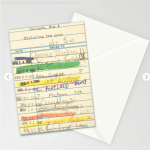
Library Card 3503 / Exploring the Moon
 This library card comes from an old copy of Roy A. Gallant’s “Exploring the Moon” and shows the circulation history of this particular edition throughout the 1980s.
Gallant has been a professor at the University of Southern Maine since 1979 and is the director there of the Southworth Planetarium. Before that however, he began his writing career with “Boy’s Life” magazine. When his article on the origin of the moon resulted in hundreds of letters of interest, he began to consider a career as a science writer.
Gallant’s first book, “Exploring the Moon,” was published in 1955 and not only sold over 100,000 copies but led to a series of ‘Exploring’ books touching on chemistry, weather and planets.
This book was, for many, an introduction to the Moon, as it would be another fourteen years before Neil Armstrong set foot on it, and four years before the Soviet Union crashed their Luna II probe into the surface.
Gallant’s career would span 50 years and include 96 titles. His last book, “Meteorite Hunter”, was published in 2001, and chronicled his journey across Siberia in search of anything related to the Tunguska Event of 1908, an unexplained explosion said to be 1000 times more powerful than Hiroshima.
Visit our shop at Society6 to see this library card and more on a variety of great products!








Harper Lee Estate Sues Sorkin Stage Production of ‘Mockingbird’
 The estate of Harper Lee, managed by Tonja Carter, is suing the stage production of “To Kill a Mockingbird” that is being produced by Scott Rubin and Aaron Sorkin.
The lawsuit alleges that the production deviates too much from the novel in regards to the portrayal of Atticus Finch, who begins the play as an apologist for the racism around him and evolves into the righteous man the world knows from Lee’s original novel and the film adaptation starring Gregory Peck.
What makes the argument the estate puts forward so ridiculous is how much the “sequel”, ‘Go Set a Watchman’, deviated from the original novel in regards to the portrayal of Atticus Finch, who is a segregationist and believes the Supreme Court acted too hastily in granting rights to African Americans.
Apparently such deviations of character are only allowed when Carter is facilitating the release of that material. Perhaps if the producers offered Carter—I mean, the Lee estate—a larger royalty, a lawsuit might be unnecessary.
Explaining the changes in character, Aaron Sorkin said, “As far as Atticus and his virtue goes, this is a different take on Mockingbird than Harper Lee’s or Horton Foote’s. He becomes Atticus Finch by the end of the play, and while he’s going along, he has a kind of running argument with Calpurnia, the housekeeper, which is a much bigger role in the play I just wrote. He is in denial about his neighbors and his friends and the world around him, that it is as racist as it is, that a Maycomb County jury could possibly put Tom Robinson in jail when it’s so obvious what happened here. He becomes an apologist for these people.”
 From that explanation and having watched Sorkin-penned arguments throughout “A Few Good Men” and seven seasons of “The West Wing” (not to mention the letter Sorkin wrote to his daughter on the election of Donald Trump), I’m eager to see the evolution and on-stage transformation of a man when faced with racism and forced to recognize it for the debilitating evil it is.
How relevant that scenario is now, that he should be given and takes full advantage of the opportunity to discuss it with a person of color. That this person person of color is Calpurnia, a black woman in his employ, should make the conversation even more meaningful. This woman, who is considered socially beneath him and dependent on Atticus for her livelihood, needs to educate and elevate him. However, it shouldn’t be lost on the audience that it is Atticus, and the entire Finch family, for that matter, who depend on Calpurnia for all their needs. How meaningful would it be to recognize that finally in this stage production and rightly attribute Atticus’ strong moral compass to the woman who set it on course?
It seems to have taken the framework of the novel and adapted it to fit with the major themes of our current world. And isn’t that what keeps theater so vibrant? The freedom and fluidity to adapt stories to fit a contemporary lens? To make a historical struggle relevant to what we may come face to face with today?
In doing so, Sorkin has embraced the spirit of “Go Set a Watchman” in that where Atticus himself wanted to break down Scout’s version of him as a flawless ideal and show her he was a man as faulty as any other. So does Sorkin’s Atticus begin as the imperfect man. In this version he is allowed to evolve and to demonstrate for the audience that we are all flawed and bigoted, whether intentionally or by privilege. But it is in confronting that ignorance, questioning it, arguing it and speaking the uncomfortable truths as Atticus and Calpurnia allegedly do, that we can grow closer to the ideal that Atticus Finch has always represented since “To Kill a Mockingbird” was first published in 1962.


 Gas Station Burrito