Category Archives: Books

Reading ‘Amos Walker: the Complete Story Collection’
 I’ve had a hard time reading lately. I haven’t been able to sit down and focus and really dig into anything. There’s always something else going on, something else on my mind, something else I need to do or feel guilty for not having done. The ‘Want To Read’ list on my Goodreads has become what the stacks of books that used to pile up on my desk or coffee table, the stairs or next to my night table used to be.
I’m almost afraid to buy any new books and that’s really no way to live. But I can’t even look at the two piles of books on my desk right now, partially hidden behind the rack of drying laundry I’m not folding in order to write this; one stack is the bunch of books I finished before my son was born, the ones I’ve been meaning to write reviews for so I can feel accomplished for having completed them. The other stack is all the books I’d love to get into, some are the next in the series, most are standalones. A few are even from the used book sale the Ken-Ton Library puts on every year that I was really excited to find last year—that’s the sale that just took place again, a year later, and those books still sitting where I put them.
I could say there isn’t enough time, but that isn’t really true, is it? There’s plenty of time, I just tend to sleep through it if I sit down for too long. Its tough to read a novel, no matter how good it is, if I crash after two pages. Usually one page I spend fighting it, so the next night I have to reread that last page again.
That’s part of the reason I went looking for Loren D. Estleman’s Amos Walker short stories. Maybe as a way to retrain my brain in small doses to sit down and relax, to fall into a story intended to be brief, to do something other then stare at a screen, whether its my phone or the baby monitor. Part of it was to learn something as well, to learn how one writes a compelling mystery story in only a few pages. If there’s one thing I’ve done less of then reading, its writing, and the lack of both is driving me a little crazy.
A good way to take care of both problems was Amos Walker and his short adventures Estleman wrote about to pass the time while the rights to any current and future full length Amos Walker novels were tied up between bickering publishers. Not only have I been catching up with the best private detective in Detroit by digging into Loren Estleman’s massive collection of Amos Walker short stories but I’ve maybe learned a little bit about the art and pacing and basic how-to of the mystery short story.
Not every mystery needs a convoluted plot or a handful of red herrings or tortured villains. Sometimes it’s just an old man who needs an alibi, a woman searching for her dog, a mob hit gone wrong, a couple of mob hits gone right, or a girl in a hotel room who should have known better then to answer the door….

Reading, “The Man in the High Castle”
“Work the sentences, if you wish, so that they will mean something. Or so that they mean nothing. Whichever you prefer.”
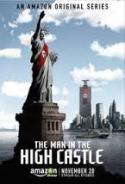 The limited previews I saw for the Amazon adaptation are what pushed my interest in “the Man in the High Castle” to the reading point. Is the show any good? I haven’t watched it yet, but I’m intrigued. Nazis! Alternate history! Episodic storytelling! DJ Qualls! Ok, maybe not necessarily DJ Qualls, but the Nazis and alternate history piqued my interest. Having read a few other Philip K. Dick novels and handful of short stories, I wanted to see what he would do with the few pieces I knew about.
The only way to explain how I felt reading ‘High Castle’, and I hope this makes sense, is to say nothing actually happened, but no one bothered to tell me.
Similar to other examples of Philip K. Dick I’ve read, there isn’t what you would normally call “world building” going on in his books. It’s more like “world immersion,” as if you wake up to this new reality and although you have no idea what or who anything is, you assume that’s how it has always been. Like laughing along with everyone else even though you don’t get the joke, you don’t freak out and try to understand what’s happening around you in this new reality. Instead, you keep reacting and moving and speaking, picking up clues and understanding things as you go, hoping no one else figures out that you have no idea what you’re doing.
In that regard, I suppose Dick’s writing is as close to real life as one can get, just with slightly more advanced technology that you still don’t know how to work.
 Sometimes this method works, such as in “Flow My Tears, the Policeman Said,” where that almost literally is the plot. It works a little less so for “Time Out of Joint,” but generally extremely well for his short stories and in “A Scanner Darkly.” You learn the necessary facts of this new reality as you go. The important details are made clear because you need them to survive. You learn by doing, by living. It’s a ‘take only what you need to survive’ sort of writing style.
This style is great, and I’ve loved it in the past, and it’s why I enjoy Dick’s books.But here, with this reality and these characters, it left me constantly waiting. We never really moved forward. While the characters were steadily doing things and interacting with each other and proving they knew on another and were all connected, it never felt like they were ever moving about in the same reality. They kept doing but never moving. Acting but never affecting.
But here, with this reality and these characters, it left me constantly waiting. We never really moved forward. While the characters were always doing things and interacting with each other and proving they knew one another and were all connected, it never felt like they were actually moving about in the same reality. They kept doing but never moving. Acting but never affecting.
I kept turning the page. They kept going through the motions. And we all kept waiting to see where we were going and whether it was worth it.
 But even as these characters met their ends and found explanations and tried to understand what they had learned from what they’d done, there didn’t seem to be much of a point to it. I was left holding a book that was more an unfinished thought then fully formed novel. I didn’t grow into understanding the reality so I didn’t care about the people in it, which was ok because the same could be said for any of the characters in it as well.
While this won’t turn me off reading more Philip K. Dick, or even deter me from checking out the tv show, this wouldn’t be the first, third or even fifth book by him I recommend. Not when he much better-written novels and stories to chose from that successfully pull off his immersion style of writing.

Reading Donald Westlake’s ‘361’
361 / “Look up 361 in any Thesaurus and you’ll find this: ‘Destruction of life; violent death; killing.’ “
 I picked up a handful of Hard Case Crime books on clearance, a couple of the authors being ones I recognized, but they sat on the shelf for a couple years before I got around to reading one of them. I started Donald Westlake’s “361” mainly because it was the one sitting closest to me while I was having some computer issues. A few bugs had caused serious delays in my computer’s ability to even idle without freezing, so while I tried to troubleshoot that, I needed something to do.
Being in a significant reading slump the last few months, I didn’t have much faith in Westlake’s ability to keep me engaged. Nothing I picked up interested me, and nothing I was reading already seemed worth grabbing. This would do, I thought, for a momentary distraction while my computer struggled to open a single web page. But I was wrong. This was perfect. This was just what I needed.
The jacket gave away the setup, but that only heightened the suspense as Westlake’s narrator, Ray Kelly, walked you through the first chapter. I’ve missed this style of writing, the rough and to the point pulp narration. Kelly himself has no patience for people throughout the book, and it comes across in everything he does and relays to the reader.
As the history of the plot unfolds you can feel the tension and mystery of all the directions it could go, the uncertainty of the Ray Kelly as he pushes forward through what he’s being told, struggling to sort out the lies, the misdirection, the motives that led to his blinding, his father’s death and destruction of the family he thought was his.
What sets this apart from the other pulp novels I’ve read is that Ray didn’t choose this course for himself in the sense that he isn’t a professional detective or criminal. He was just a guy who was discharged from the Air Force, happy to be reunited with his father and heading home.
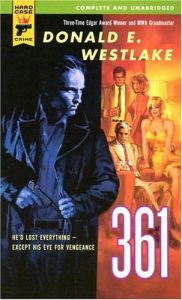 In a way, that makes Ray just like Ed Johnson, the private detective who tries to help him but is (as perhaps as the most realistically written private detective in the history of pulps novels) terrifyingly out of his league when he learns his client is getting involved with violent criminals; and Eddie Kapp, the gangster who holds the secret to the death of Ray’s father, and who until Ray came along was content to retire to Florida and leave the underworld behind.
But where Johnson refuses to push on and leaves Ray on his own, and Kapp throws himself gleefully back into the New York mob scene, Ray is simply a scared, hurt man, who has had everything taken from him. He wants justice and is willing to do whatever is necessary to achieve it.
Unlike the characters in similar books who suddenly find themselves at home in the darkness where their vengeance lies hidden, Ray has no interest in that life. He’s simply a man who wants to go home, but is willing to kill any man who tries to stop him.
Follow me on Goodreads for more reviews and to see what else I’m reading….
Thanks to the Violent World of Parker for explaining the title and sharing the original cover art.


 Gas Station Burrito