Category Archives: Buffalo

Still Rebuilding from Prohibition, Because It’s Always a Rebuilding Year
or, How My Unbeatable Liver Uncovered a Conspiracy Built Completely on Heresay
Some days, for whatever reason, you want to drink yourself stupid. That’s easy enough to accomplish. Other times it creeps up on you and you’ll go from feeling pretty good with a gin & tonic in your hand to sleeping on the couch in your clothes with the burnt remains of a pizza that sat in the oven for six hours.
The other night I found myself faced with option three: no intention of getting sloshed and apparently lacking in the physical ability to do so as well. You keep ordering drinks and even toss in a shot or two before your buddies start bailing on you, but it’s not sticking. There’s a hint of a buzz creeping in, but not much else and now that other group of idiots with their smarmy ringleader who has a permanent duck-face and Jersey Shore wardrobe who totally cheats by leaning three over the line to take his shot has edged you out from the dartboards. You’re all right calling it quits and heading home.
The good news is that the next morning you wake up and remember how you got there and made it all the way through the movie you put on, even if that movie was Sweet Dreams
 The Pierce Arrow Building, in case you’re not aware, is the massive complex facing Elmwood Avenue between Amherst Street and Hertel Avenue. It was built in 1906 for the Pierce Arrow Motor Car Company by Albert Kahn
Thankfully, unlike the Larkin Administration Building, after Pierce Arrow declared bankruptcy in 1938, the complex carried on and still stands today. It was divided into smaller pieces for an assortment of companies and businesses over the years from theater groups to casino dealer training. And now a distillery.
 In 1887 there were three distilleries in New York State, two of which were in Buffalo. Until Prohibition shut it down after 70 years of operation, C. Person’s Sons was considered the finest distillery in the state. There may not have been much competition for that title, but they were well regarded for the quality of their product and respect for their customers.
It may have taken quite a bit longer for distilling to come back to Buffalo then its brewing counterpart, but now we have Lockhouse Distillery. From what I’ve heard, it’s been worth the wait. Originally named Eight Buffalo Spirits, Lockhouse has so far released vodka but is already aging rye, and plans on tackling gin this summer. After selling out of their initial 800 bottle offering in less than two hours that business will surely continue to grow. Their expanded products is similar to what C. Person’s Sons offered a hundred years ago and given their predecessor’s reputation, that’s not a bad legacy to pick up. Lockhouse certainly is on its way since just recently they won the gold medal for grape-based vodka from the American Distiller’s Institute.
The interesting part of our conversation wasn’t even about the distillery at all. My friend had talked briefly with one of the guys behind Lockhouse about how they ended up in the Pierce Arrow Building. Finding a suitable location wasn’t that easy since it seems all those unused buildings and empty lots around the city aren’t as ignored and neglected as they seem. Most of those commercial properties that would have been suitable for their needs were owned already but not in the absentee landlord sense we all assumed. They aren’t owned by real estate speculators hoarding lots for a big payday when a new hotel or strip mall is proposed by one of the big name developers, allowing them to cash in. These properties are part of a plan with development projects in various stages of planning.
I’m not naïve enough to believe these developers are investing in the city simply out of the goodness of their hearts. Their financial futures are tied directly to the city’s. The improvements on the waterfront will lead to further development with Ohio Street, the Webster Block, Uniland’s new Delaware North headquarters that began construction recently at Delaware and Chippewa. The continued expansion of the Buffalo Niagara Medical Campus brings improvement to any vacant property within two blocks of anything they slap their logo on.
These projects aren’t spontaneous. There’s no mad dash to flip the nearest empty building every time Ciminelli, Rocco Termini or Uniland announces a new project. The plans are in place, property is owned and proposals are flying. This may make it harder for companies like Lockhouse to find a suitable location, but they will. Their success, the success of independent pipe-dream niche businesses, however small or grand, any idea what begins with, “Hey, wouldn’t be cool if—” is tied to the success of these sprawling mixed-use developments like HarborCenter or the renovated FWS building on Elmwood that Buffalo Spree recently moved into, intended to become part of “Pierce Arrow Village.”
The average person only sees a piece of the puzzle in North Buffalo or a piece of it along Fuhrman Boulevard and can’t comprehend that it’s all leading towards a grander integrated vision. These developments have not happened by chance or accident. There is a plan.
“They know what they’re doing,” my buddy said, “This city… in ten years we won’t’ even recognize it. It’s going to be amazing living through that.”
He’s one of several people I know who bought a bottle of Lockhouse Vodka. It may be amazing to witness the changes in the city, to watch us feed our post-industrial sickly self, and watch as pound by pound development companies put some meat on our bones. It’s even more amazing to be a part of it, even one $35 dollar bottle of it at a time.

Re-Imagining the Metro Rail
 Looking for old articles on Crossroads Arena reminded me of something I was working on a while ago where I re-imagined Buffalo Metro Rail signage according to NYC standards. They turned out pretty well, even if with our one line they weren’t as visually informative (confusing) as MTA signs. I had multiple variations made for the Special Events station that lets off at the arena with the different names that had been used over the years, along with a generic Downtown one. The same was done with the Seneca Street stop and Pilot Field through its current Downtown Ballpark designation, and I got a good response to one for the closed and now demolished Theater Station. But until I started looking into the background of the arena project it didn’t even occur to me to make a Crossroads.
 Currently I’m working on a variation of the Metro Rail signage according the K-D-R standard that found widespread implementation by the CTA beginning in 1977 on Chicago’s L. These are boring too, when they get translated for Buffalo. The design itself was meant to be simple, easy to read and uncluttered. And it is, but when Chicago’s signs feature directions for the Red Line Loop to South Side connections and all we have to boast is the end of the line at University Station, uncluttered becomes boring.
But in making these variations I can’t help but think of the stunted light rail system we have now, lacking in the grand scale of the original project that would have seen lines extending into the northern suburbs and even up to Niagara Falls. The Metro Rail officially opened in May 1985 after six years of construction that was behind schedule, over budget and just generally pissing everyone off. The additional lines never found funding because by then the city population was steadily declining and the fear was that no one would be around to use the existing Downtown to South Campus line.
The original proposal shows several stations beyond South Campus, including UB North Campus and extending into Amherst. The Tonawanda branch would have included six stations and extended into North Tonawanda. These Phase 2 extensions would have tripled the size of the Metro Rail. Consider the fact that our 22 minute long 6.4 mile single rail line right now serves over six million people a year. What would it mean for ridership for Amherst or Tonawanda residents going to a Sabres game or a concert at Canalside? Not to mention the people working Downtown and living in the Northtowns, or vice versa.
There have been numerous proposals and studies over the years to expand the Metro Rail line, from suggestions of connecting the airport with the Church Street Station to former UB president John B. Simpson planning to connect the three UB campuses with a cohesive transportation system, the Buffalo Niagara Medical Campus supporting expansion of light rail to feed their growing development, and perhaps most importantly (or most tangibly) the reconstruction of Main Street to integrate light rail and two-way traffic.
Developers are embracing the city’s past at Canalside, building on its present with the Webster Block, and bio-tech research is redefining our identity for the future. What if we could connect Western New York? What if Tonawanda, Amherst, and the airport, with all of its local and visiting travelers, all fed into the heart of downtown Buffalo along Main Street?
While we foam at the mouth for any development in our area to prove that Buffalo isn’t out of the game yet, it may come at a price. Over thirty years ago the original proposal for the light rail was made. The physical resources were there for those lines, and by that I mean the space, the real estate. But for how long? It’s time to finish what was started when they broke ground in 1979 and in doing so connect everything that we’ve accomplished since then in rebuilding our city.

the Crossroads Project / an Investment in Buffalo’s Past and Future
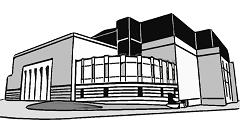
Buffalo Memorial Auditorium
Something I’ve been working on recently brought to mind the original name of what is now the First Niagara Center in downtown Buffalo. When the project was first announced and throughout the funding and construction phases, the new arena to replace Buffalo Memorial Auditorium was known as Crossroads Arena.
I was only about twelve at the time, but thought that was an pretty awesome name. I don’t think I was alone, in fact, I think just about the entire city thought that sounded great. The name followed its purpose, as this nearly 20,000 seat arena has hosted everything from hockey, lacrosse, arena football, soccer, to concerts, college basketball and professional wrestling.
Of course, then everyone’s heart was broken with the naming rights inevitably sold off and Crossroads Arena was suddenly Marine Midland Arena. Which was, you know… lame. Apparently people in Buffalo don’t swear enough so in 2011 First Niagara acquired the naming rights and we were given the ‘effin center’. But until then it was most commonly known as the Arena. The Aud, the Arena, the Ralph. We do what we want.
This was the first major sports complex built in New York State in 20 years and more than half of the $127 million bill was secured from private sources, the rest coming from city, county and state sources. It took several years to get the project off the ground during which time the Sabres’ owner Seymour Knox III had to threaten the sale or relocation of the franchise.
In an article from June 1995 I came across the line, “Local and state officials hope that Crossroads Arena will act as a catalyst for the long-awaited rebirth of the Buffalo Waterfront.” Well, it’s taken nearly twenty years but it seems that hope is finally coming to fruition with the almost continuous announcements of projects and proposals in the downtown area focused on rebuilding the waterfront. The HarborCenter project, with two ice rinks, training facility, indoor parking, a 205-room hotel and other restaurant and retail space, is currently under construction on Webster, adjacent to the arena. Canalside and the Commercial Slip has been gaining ground since 2009 in rebuilding portions of the canal system that made the city an industrial hub. With concert series, festival and its weekly Saturday Artisan Market, as well as the Military & Naval Park and Liberty Hound restaurant, the Erie Canal Harbor Development Corporation has been steadily revitalizing the area.
So maybe the name has changed, from Marine Midland to HSBC to First Niagara, but the idea behind the arena is still there. It was called the Crossroads Project before any other name, and while that may initially have simply meant a single location for large sporting and entertainment events in the city, its presence in downtown Buffalo has made it a crossroads of something much more. With the construction of HarborCenter and the rebuilding of the Commercial Slip, the arena has anchored the crossroads of Buffalo’s past and future. It may have changed names and it may have taken almost twenty years, but the investment in Crossroads Arena seems to finally be paying off.


 Gas Station Burrito