Category Archives: Culture

Considering Potential, Adversity and Alice Childress
I came across a post the other day referencing the Biosphere 2 project and a surprising discovery scientists made during the experiment. Within the completely perfect and balanced contained world of the biosphere the trees appeared healthy and thriving but none would grow to maturity. Before they could reach maturity however, the trees would topple over.
The scientists realized that within the biosphere there was no wind, there was no pressure or adversity exerted in the trees. They grew without resistance, without hardship, without adversity. The easy explanation is that the wind forced the trees to grow stronger, deeper roots to fight the outward forces of nature and their surroundings, but the truth goes far deeper than that.
It was more than strong roots the trees needed to rely on and develop, it was a tougher skin. There is a layer of wood known as reaction wood, or stress wood, that the biosphere trees were not developing. This layer allows the trees to adapt and to branch out in directions and at angles that would otherwise not be structurally sound in order to find the sunlight and other resources they need. In a perfect world they didn’t need that stronger layer, that muscle and fortitude. They grew fast and straight and collapsed under their own weight, too weak to maintain themselves because they had never faced any adversity, had never had to fight. They could never reach their true potential because they had never been challenged to do so.
 I was reminded of this a few days later when lookin through my materials on Alice Childress, an author, playwright, actress and woman of color who worked fiercely for four decades in theater and on Broadway addressing social issues through her work during a time when she was denied basic civil rights. She began her career in 1949, writing and starring in the one act play, ‘Florence’ which touched in many of the themes that would define her career and the social causes she would fight for; the empowerment of black women, interracial politics, working-class life.
“My writing attempts to interpret the ‘ordinary’,” she said, “because they are not ordinary. Each human is uniquely different. Like snowflakes, the human pattern is never cast twice. We are uncommonly and marvellously intricate in thought and action, our problems are most complex and, too often, silently borne.”

Reading the Intentional and Not So Intentional Absurdity of Catch 22
I never had to read Joseph Heller’s “Catch 22” in high school but chances are if it had been assigned I wouldn’t probably wouldn’t have finished reading it. The novel is a too-long absurdist, occasionally funny, often sickening accurate and poignant, novel set during the Second World War, of a bunch of men screaming louder and louder because no one is listening them, while sexually assaulting most of Italy.

Weaving throughout the narrative exploration of a myriad of damaged soldiers is the emotional and psychological cost of toxic masculinity, on those wallowing in it as well as to everyone they come in contact with.
The greatest expression here of this cultural malignancy is the bureaucracy of war; whereas war is wage to provide a hierarchy for men to exploit one another, and that bureaucracy is then maintained to continue to wage a futile and pointless war that creates victims as much in those who are bombed as those who are bombing. Perhaps those who order the bombings can be said to be immune to the effects of this culture and the war it wages in reality, but they most certainly have a form letter explaining to “Mrs., Mr., Miss, or Mr. and Mrs. —” that it is they who are the real victims in all of this.
But I also have to wonder how the new Hulu adaption of the book will address the cultural and sexual shortcomings of the book in today’s Me Too and Time’s Up movements. Or will that charming and wistful reminiscing of the good old days when a fraternity gang raped two underage girls be excised entirely from the retelling?

It’s certainly a difficult book to read, and one difficult to say was enjoyed, despite the humorous moments. But for its stark, absurd illustration of the power of communication, miscommunication and misdirection to corrupt and damn, and the effects of war, of unchecked and unrestrained aggression it is an important story to experience. And one that, despite being dated in some aspects, is just as relevant today in the lessons that still need to be learned and the warnings to be gleaned.

Reading Chuck Wendig’s ‘Invasive’
Attack of the Killer Ants, and Other Adventures in Paradise
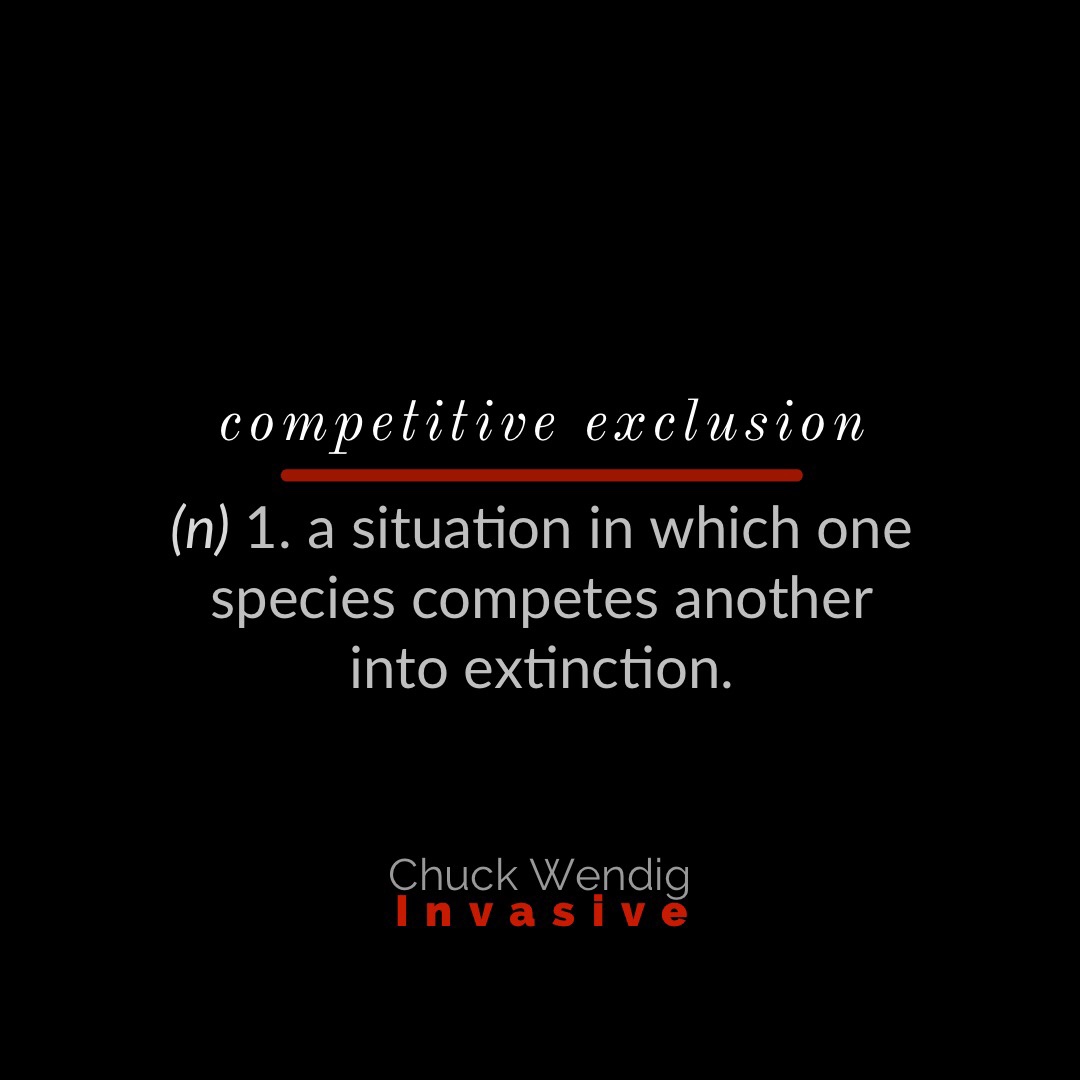
competitive exclusion /
(n) 1. a situation in which one species competes another into extinction.
2. the inevitable elimination from a habitat of one of two different species with identical needs for resources.
While I didn’t love the book itself, despite enjoying Chuck Wendig’s writing style and Xe Sands’ narration, there were certain elements of the story I found fascinating. One prominent idea in the novel was the concept of competitive exclusion, and regardless of what was happening in the book with genetically modified killer ants, it was a concept that grabbed my attention for its implications beyond the themes of futurism and doomsday/survivalist prepping. Eliminate the characters, the ants, the hi-tech monster story and the shell game of human monsters pulling strings throughout, and you still have this concept.
We live in a world of finite resources. But we have also been poisoned to believe that finite means limited, and that in order for you to have enough, I must not. We have been indoctrinated by survival of the fittest, despite us all having the potential to be fit enough to thrive.
Read the definition again. Rethink the concept. Competitive exclusion is not what our initial assumption assumes it to be. It is “a situation in which—”
It is a situation. It is a situation in which two organisms are made to compete against one another. And much like in Wendig’s novel, it is a situation created and constantly influenced by those in power, those with wrath, those with unlimited resources all at the expense of those with no knowledge, no shelter, no protection beyond what might be scraped together during the panicked stampede of an isolated island’s population.
So while we may not be trying to escape face-eating genetically modified ants, it might be useful to look around at rush for resources we see everyday in the ‘fight for $15’, in teachers union strikes across the country, in food deserts in every community in the wealthiest nation in the world, in lawmakers threatening to take away school lunch funding to schools that fail to hit standardized test standards, in billion dollar companies run by millionaires eliminating jobs and closing factories to maximize profits, and the elected officials that earned tens of thousands of dollars voting against needs of thousands for the benefit of a few. All of this is an engineered situation that depends on anhysterical and uninformed reaction by those with little power so that the few can hoard resources and stockpile assets beyond what could be conceivably utilized.
Now that I think about it, we might have a better shot against the ants.


 Gas Station Burrito