And Then She Asked If I Wanted to Hear a Funny
A customer asked me the other night if I wanted ‘to hear a funny.’ Being exhausted and not immediately able to translate I asked, “A what?”
“A funny,” she repeated with a bit of an edge to her voice. When she spoke it was as if through clenched teeth, and her eyes were suddenly attentive and aware of her surroundings. Anyone who’s worked customer service knows that’s a dangerous state for a customer to be in. A feral growl would have been the next logical progression of emotion should I have not suddenly understood she meant to tell me a joke. I found myself afraid.
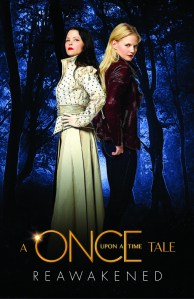 Given that we had bonded already over my enjoyment of and her rabid obsession with the show Once Upon a Time, I knew that whether I wanted to hear her ‘funny’ or not, I was going to listen.
You see, we’d met earlier that night when she brought the new Once Upon a Time book, Reawakened, to the desk and asked what specifically it was about. Granted, she had the book in her hand and could easily have answered the question herself, but it was a slow night. I told her it covered the first season.
This was disappointing news for her until I quoted Wikipedia’s promise that it would give “fans of the show a whole new look at their favorite characters and stories.” Boy oh boy did her spirits lift at that news. She was certainly in for a treat, although the customer in line behind her looked slightly terrified.
This look of terror was not properly interpreted by my Once Upon a Time customer.
“Aren’t you so excited?” she asked the women behind her, “Do you watch Once Upon a Time? Isn’t it so good?”
It turned out this customer was not excited since not only was she not a fan but had never heard of the show before. I was sincerely worried for this ignorant customer, scared she may be mauled in a hysterical fan-rage when she innocently responded, “Once Upon a Time? I’ve never heard of it, is that a TV show or something?”
I tried to make eye contact with her in an attempt to signal she should back away slowly and not engage the woman further, but thankfully another bookseller came to the desk and helped her, ending the conversation.
We talked about the show a bit more, I confessed sadly that I was a few episodes behind on the current season and begged her forgiveness for this, and showed her the books we had on fairy tales. After that we parted ways, her to her crazy and I to cleaning up the crap customers had left all over the store. I thought we were done. I was wrong.
“Do you want to hear a funny?”
“A what?”
“A funny.”
“OK?”
“If you’re a Russian in the kitchen, what are you in the bathroom?”
“I don’t know.”
“If you’re a Russian in the kitchen, what are you in the bathroom?”
“No, I still have no idea.”
“European. Get it?”
Maybe it was how late in the night it was; maybe this joke really is funny. I don’t know, but I laughed. And not just because I was too scared of her not to.
European. Yeah lady, yeah I get it. I see what you did there.
Aaron in Ten Years
I had to tell a woman today that my friend was dead. It had been almost five months but she didn’t know. It was five months empty because he wasn’t there. Five months wishing he still was. Five months of being reminded of him every day we would have worked together. There was still an empty space in those days where his smile should have been. It had been five months, but he was still dead.
How do you tell someone that? How do you look this woman, a perfect stranger, straight in the eyes and tell her that he’s dead? Nineteen years old and he’s dead.
“He was so nice,” is what she told me, “He was such a nice boy.”
That’s what everyone says, too. He was nice, so nice. The nicest person you could know. Always smiling. That’s one of the things we miss the most around here. His smile. He was always smiling. He’d walk in and no matter how late he was or the reason for it, he’d be smiling. He didn’t smile because everything was perfect and nothing bothered him. His life wasn’t perfect. But it was his life not ours. So when he saw us, he smiled. Around us the rest of the world, that world beyond the doors of the store, didn’t matter. The rest of his life couldn’t bother him there. So he smiled.
The rest of his life couldn’t bother him. The rest of his life. Didn’t even realize how that came out. The rest of his life. Nineteen years old and the rest of his life doesn’t exist anymore.
He was only trying to help his friend. Some people could look at what happened and say that’s why they don’t put themselves on the line for anyone, just mind your own business. But that wasn’t him. That’s not the type of person or the type of friend that he was. His friend was in trouble and he had to help him. He had to, whatever the cost. Whatever the cost…
Not many people would agree with that. Not many people would do something for a friend no matter what the situation was. He would. He did. His friend was alive.
It’s easy to look around and say that it seems like the best types of people are dying. Or is it simply that those deaths are the ones that stay with us. The senseless death. Those are the ones we can never forget. The tragic death.
The people dying are the best types of people because they’re willing to put themselves on the line. They’re willing. Not willing to die. That isn’t their intention. They’re willing to stand up when no one else will, to step in when everyone else has put their head down. Not many people would do that anymore.
Everyone says they would. You hear it all the time. I’d do anything for you. I would die for you. I’ll be there for you no matter what. But what does that mean today? Today that means I’ll do anything for you that won’t take too much time or energy or inconvenience me in any way. Today that means I’ll die for you until I feel the slightest bit of pain and then you’re on your own; then it’s your problem and you need to deal with it yourself. Don’t worry, it will teach you a valuable lesson. You’ll be better off if I don’t intervene.
People who say that never mean it. It’s the people who are afraid to say it or the people the thought never occurred to who would be the most willing when the time comes. Words are meaningless. Words are a waste. How you live is how you are remembered. In some cases, too, it’s how you die.
He was always smiling. No matter what, he was smiling. Everyone, when they talk about him, that’s the first things they all say. They miss his smile. There are endless stories about him. Endless good times. Funny stories. Almost endless. They remind me how little I actually knew about him. I barely knew beyond the smile. They knew him better, and I’d listen to every story. They all had one. I suppose this is mine.
Senseless death. Senseless.
That’s what the woman kept saying. First she was shocked. Shock. Disbelief. And then— “How?”
I had to tell a woman today my friend was dead. Then I had to tell her how, at least the version of how that I had heard. But I couldn’t tell it all. I couldn’t tell the story; only that he was stabbed helping his friend. Protecting his friend.
Her reaction spread to me. My knees felt weak, my hands shook. My voice caught in my throat each time I tried to answer. And my eyes… everything started getting a little blurry. When I could finally answer so did hers.
He’d been dead five months. Five months and she didn’t know. Five months and I had to be the one to tell her when she asked, “Is Aaron working today?”
I had to tell this woman with the only words I could find, “Aaron died.”
About ‘Aaron in Ten Years’
A while back I ran into a guy I used to work with. Hadn’t seen him much since he left, but we’d kept up a little bit on Facebook. I’d just hit that magical optimal beer level of friendliness that socially awkward introverts find themselves at where we can talk to anyone about anything and its all pure poetry and life changing conversational bonding. This is also known as, “One more beer and I won’t remember how to sit on this barstool anymore.” It’s a fine line.
Being at this point in my drinking, when I recognized him I was thus uninhibited and said hi in the artificial, “Mike? Is that you?” fashion one for some reason uses even knowing full well who it is.
It was. We got to talking. He’d just gotten a job at a newspaper, which surprised me since I didn’t think those existed anymore—newspapers and jobs—and he shared my disbelief. It was a small paper, but a great way to get into the business. Print newspapers may be on their way out in the sense of how they’ve existed so far, but journalism—writing—isn’t going anywhere. It’s changing shape and adapting to the evolving digital landscape, but the concept behind newspapers will not vanish entirely. And in this he was excited, not just to get a job at a newspaper, but to get into the business as he was.
We talked about his brother, we talked about old times at the pet store where’d we’d all worked along with his brother’s wife before they’d gotten married and moved and had kids.
And then he turned to his girlfriend and said something that made me turn and stare at him:
“Remember I was telling you about Aaron? Matt wrote that story about him.”
At that moment we were at Gordon’s, where I spend most Friday nights due to some friends who have spent most nights there over the last five years. Ten years ago one of the owners of Gordon’s, Corey, started a small literary magazine in Buffalo called Blinking Eights.
It was a simple magazine: heavy paper folded and stapled together, sponsored by local businesses like Bubble Tea and probably Kinko’s where it had been copied and put together, and given away for free from the window ledges of businesses around the city. It wasn’t long, it wasn’t fancy, but in the very first issue a short story I wrote was published.
Like Blinking Eights, that story wasn’t long, it wasn’t fancy, and maybe it wasn’t even that good and Corey just needed something to throw on the last page. But Mike remembered it.
A while back I got to work on a film that was shot in Buffalo. I helped out around the set for a few days, and after the last day of filming got invited out with the rest of the crew. In a drunken conversation with one of the writer/stars I told him how amazing it was that he’d done this, that they’d done this—wrote a movie, made the movie, it was unbelievable.
We talked about the goal of any artistic creation, be it a film, a book, a song, painting, poem, sculpture, whatever—to touch someone. Even just one person. Even if only one person walked away from that experience and remembered it for the rest of their lives, it was worth it. Not every book or story or movie will be a record sales billion dollar experience. Some don’t need to be. Some need only to be read or heard or watched by the right person at the right moment in their life that it changes them. It reminds them they’re not alone.
At the time I had no idea that something I’d written had that effect on someone, on someone I knew. It gives you hope. I didn’t think anyone remembered it. I’d only thought about Blinking Eights and ‘Aaron’ a handful of times since then, why would anyone else remember it? Mike did. It stuck with him, it helped express how he felt after Aaron died, and as someone who had known Aaron better then I, and it helped him.
I can’t find my copy of Blinking Eights, but I knew it’s around here somewhere. I thought that ‘Aaron’ was lost then to an old computer that’s rotting away up in my attic, but it turns out I had a copy of it after all. I went through it, revised it a little bit. Not much. Just enough to add what needed to be there, what only ten years and a chance encounter with an old friend could add. Maybe it still isn’t any good, but the ending for me was the same. I had the same reaction reading and rewriting it that I had the first time I wrote it ten years ago.


 Gas Station Burrito