Category Archives: Books

Reading “God Save the Child”
 My only complaint when I started reading Robert Parker’s ‘Spenser’ series came in the first book, “The Godwulf Manuscript” when Spenser, crossing a college quad, described in great detail the clothing of several students he passed. For nearly two pages Parker shared the early seventies fashion to be found on a college campus, displayed by characters without names or purpose or bearing in any way on the story at all, and when I started the second book in the series, “God Save the Child”, it seemed I was in for more of the same.
Maybe it was that this was the second book and with that came a growing appreciation or familiarity with Parker’s writing style, but I started to understand why this was the case and why it had to be. Spenser narrates these stories and he’s as clever and sharp-witted as any private detective from the days of Chandler and Hammett, and big enough to get away with having a smart mouth if the guys he’s mouthing off to can keep up and realize he’s insulting them.
But where Parker goes into exhaustingly more detail then the classics of detective fiction is less about sloppy or tedious writing. In order to put us in his detective’s shoes, he has to also put us in his detective’s head.
It took Spenser just about explaining this to his love interest in “God Save the Child” for me to understand as well, so I clearly don’t make a very good detective. Spenser, on the other hand, is good at what he does specifically because he notices and remembers everything. He sees a person’s shoes and remembers their pants, the color of socks and shirt and jacket, the cut and color of hair and whether the glasses were prescription or just for show, and whether they matched the rest of the outfit as well; and he does this for every person he passes, everyone he comes across from the moment he meets a client because any one of these people may be a part of his case, and he may need that information later.
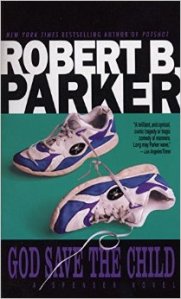 Spenser isn’t a hero or a supercop or some action star. He’s just the guy working a small-time case trying to figure out where someone or something went and whether it needed to be returned once he found it. In the course of this he’ll tell you what he made for breakfast and describe his workout routine, and you might even be able to cook a pork tenderloin en croûte if you pay attention.
Robert Parker understands that this is tedious work, undertaken by the kind of man willing to notice details and keep each and every one of them tucked away for the moment he will need to put those pieces together the right way. From an author’s perspective, to realistically write such a tedious undertaking itself needs to become tedious.
This writing and narrative style that at first turned me off of Robert Parker is precisely what takes the reader more completely into the world and mind of a private detective than any author has before. He does this not by hinting at the details the reader should remember or teasing the threads that will be important later, but by immersing the audience in the overwhelming detail of the world and letting them sift through to identify the important parts alongside the narrator. It’s this style that makes the Spenser series so intriguing, and interesting to continue reading.
Follow me on Goodreads for more reviews and to see what else I’m reading…

The Actually Not Brief At All and Even More Frightening Reign of Phil
Phil is a terrifying creature. He is bitter, vindictive, opportunistic, petty and his brain regularly falls out, which leads to some of his more outlandish moments and thankfully, his ultimate downfall.
And unfortunately, reading this novella within the context of the current presidential election, Phil is an all too recognizable figure. You can hear a distinct voice as Phil begins to rant about border protection and keeping those lazy, puny Inner Hornerites out of the vast, good and generous Outer Horner. Phil speaks in simple, passionate, fear-mongering language meant to evoke an immediate, emotional, knee-jerk patriotic response.
But Phil isn’t Donald Trump. Except that he is. And, according to the author, so am I. And so are you.


“The story came to be about the human tendency to continuously divide the world into dualities,” Saunders wrote in his essay, ‘Why I Wrote Phil’, “and, soon after, cast one’s lot in with one side of the duality and begin energetically trying to eliminate the other.”
Taking more than five years to write, the ghost of an antagonist that haunted Saunders’ subconscious while he worked on ‘Phil’ changed forms constantly, from Hitler to Stalin, the atrocities in Rwanda, Bosnia, the Holocaust and, as time progressed, “Islamic fundamentalism, the war on terror, the invasion of Iraq, red states vs. blue states, Abu Ghraib, Shia vi. Sunni, as well as smaller, more localized examples of Us vs. Them.”
Some characters try to fight back against Phil, and some recognize that what he is doing is wrong but are afraid to act. Others follow along, kissing up and betting on what looks to them like the winning horse. After all, Phil has the loudest voice. He’s speaking his mind and the people really like that. He knows how to manipulate those around him, including the media.
Not all are fearful or cowardly and the world at large begins to fight back, but it’s ultimately Phil’s own ego that brings him down (with a little divine intervention) and saves the world of Inner and Outer Horner. Even then, that tendency to see “us” and “them” comes through, and you understand that this was probably not the first and would not be the last time a scenario like this would play out.
Check out Saunders’ own essay that gives a little more background into how the novella came to be, even though I’ve quoted a good amount of it for you already. If you have read the book already and enjoyed it, or if you’re interested in the craft of writing and how one gets from Point A to Phil, you should read it.
(And if it’s the latter reason, go and watch his video from the Atlantic)
Saunders has mentioned how at one point the book was over 300 pages. Eventually, he found it necessary to cut it down for reasons of pacing and tone, but sometimes an author just can’t let go. On ReignofPhil.com you can read what hit the cutting room floor in the outtakes section, with a little background on the scenes and why they didn’t make it. It’s a great behind the scenes look you don’t always get with books, and it’s a pretty cool website, so take a look.
Follow me on Goodreads for more reviews and to see what else I’m reading….

The Folly of Expectations: Reading Salema Nazzal’s ‘The Folly Under the Lake’
An article I came across about a secret ballroom built in the 19th century beneath a lake piqued my curiosity and led me to search out more information and photographs about this incredibly intriguing hidden marvel. The history of Whitaker Wright, his property at Lea Park where the underwater ballroom is located, his shady business deals and eventual suicide when his deception was uncovered seems ripe to transform into any number of plotlines and stories.
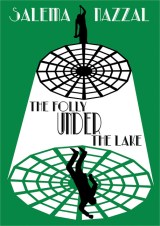

To be honest, I underestimated “The Folly Under the Lake”
Initially, I was put off by being thrust into the story through two characters who seemed set up to be a secondary, annoying couple you pity but deep down can’t stand. From there, too many characters were introduced too quickly where I got to the point I didn’t care who was talking anymore and had no interest in trying to keep them apart.
But I kept reading and they kept talking. And talking. And there was a lot of dialogue. But then I told myself to stop trying to hate the book, to stop trying to look for what was wrong. I would read a couple chapters and put it down, read a couple more the next night, and during the fourth day, when I was six or seven chapters in, I found myself excited for later when I would get to pick it up and read some more.
While this was not a great book, it nevertheless had me hooked.
Whether it was my interest in the underwater ballroom itself or curiosity over how Walter would be killed, and whether I was right about who did it (I wasn’t), I was excited to keep reading it, pacing myself as I did to tease the story out.
Could “The Folly Under the Lake”
But ultimately, it was a fun read and I enjoyed more than I expected I would. The book did exactly as it needed to keep the reader engaged and moving forward through this little murder mystery, offering up valid suspects in each of the characters that kept you excited to read on and solve the crime.
Follow me on Goodreads for more reviews and to see what else I’m reading….


 Gas Station Burrito