Blog Archives

Village Green Bookstore
 Village Green Bookstore opened in 1972 in a 600-square-foot basement store at 766 Monroe Avenue in Rochester, New York, before its reputation among the community’s book lovers spread and it expanded into the larger storefront upstairs.
The store had a coffee bar before they became common in bookstores and despite starting out by selling only the local Sunday edition, would offer more than 100 newspapers and 2,400 magazines. Eventually, while books were still a staple of the business, they became lost behind their rapidly expanding merchandise line.
By 1992, Village Green had added as many as eight new stores throughout Central and Western New York, including locations at 1089 Niagara Falls Boulevard in Amherst and 765 Elmwood Avenue in the Elmwood Village. But the growth for the company had become troublesome. Hoping to solve their financial problems, the chain continued to expand locations and product offerings. In doing so, as tends to happen when a company forces growth in order to dominate the market, Village Green forgot their purpose and mission. The company had forgotten what one of the founders, John Borek, had said not long after opening; their intention was to cater to “people who were hungry for books.” Instead, they were selling ice cream and inflatable bagels.
Within a few years they had added stores in Pennsylvania and New Jersey, but with a series of catastrophic financial decisions that involved lawsuits, criminal charges and SEC investigations, the company began closing “underperforming” stores, including a third location in Western New York, in the McKinley Plaza in Blasdell. The closures and merchandise sell offs could not keep the company afloat however and in 1998 they had filed for Chapter 11 bankruptcy protection.
The following year, the flagship store on Monroe closed it doors for good, eventually becoming a Pizza Hut.




All Booked Up at the Buffalo & Erie County Public Library
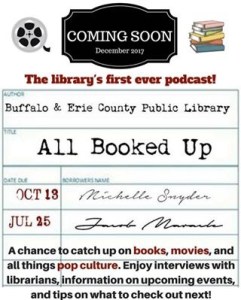 Library? Podcast? Sold.
I just finished listening to the first episode of “All Booked Up” on SoundCloud, a new(ish) podcast put out by librarians Michelle and Jacob with the Buffalo and Erie County Library.
I put it on while I was shoveling the other day (which I don’t necessarily recommend as I started laughing a few times and had to stop) and finished it later while folding laundry (a much safer activity while listening to this), because that’s just the jack of all trades that I am.
I loved all of its geeky rambling about “The Disaster Artist”, “Dunkirk” and “The Big Lebowski” and everything the Library has to offer to take you into those stories and beyond.
I was a little scared when Michelle started professing her genuine love and obsession for “The Room” but then I remember I own multiple copies of “Manos: The Hands of Fate”, a movie made by a fertilizer salesman just to prove he could and whose title literally is “Hands: The Hands of Fate”. What does that even mean? Why does it seem like two movies spliced together? Seriously, what is happening with Torgo? Why am I watching it again?
Yeah, so I guess who am I to judge, right?
The podcast’s hosts are true librarians, who can work multiple recommendations into a conversation without it being overwhelming, and their suggestions are informed by their own reading history and interests. They’re not just throwing suggestions at you or reciting a bestsellers’ list, but recommending books and movies they have available through the library based on the conversation they’re having. The episode notes include a list of all the books and movies they talked about as well as links to those titles on the library’s website. So if something sounds really interesting, you can immediately click over and request it from your local branch.
I’m looking forward to catching up and listening to the rest of the episodes they have up, and checking out some of their recommendations. It’s available now on SoundCloud and iTunes.

Seconding the Case for ‘Bland and Boring Bookshelves’
I recently went to a party in a trendy studio apartment, and for a moment was horrified by the bookshelf I glimpsed from the corner of my eye along a darkened wall of the living room. I say for a moment because once my eyes adjusted I realized my hosts had simply removed the dust jackets from their predominantly hardcover collection of books; and although the bookshelves were scattered with other decorative items and the books seemed to arranged with some measure of restraint and foresight that has never accompanied me to a bookstore, rather than jammed into every available space as mine tend to become, the shelves weren’t overwhelmed with the need to be a curated, controlled display. While there were some minor shortcomings to the these bookshelves (they needed to be at least 35 times their size) it certainly wasn’t as bad as it could have been.
I have to agree with Cathy over at Kittling:Books in that too many interior decorators and the HGTV-fueled need for staging our living space push the trend of messing around with the heart and soul of any house. To many of them, bookshelves are bland and boring, and they’re constantly trying show off how original they are by forcing out ideas intended to spice them up.
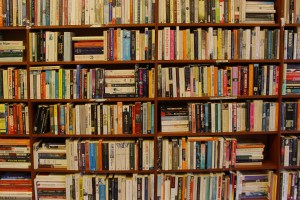 The books will be displayed spine-in or covered in plain white covers, or the books are shelves by color, fading down the rainbow along their floor to ceiling shelves dotted with Pop figures and other decoration meant to show how trendy and tied into pop culture the owner is, or they shove furniture right up against the shelves, blocking the books that would be within easiest reach to one sitting or lounging on the floor as the spend an afternoon digging for the perfect read, or hang framed prints from the shelves and supports, blocking the books as the frame jobs insist on a matte that thinks it can transform a 4×6 snapshot into a 32×48 art exhibit.
It’s become clear that many interior designers are not readers and know little about the proper way to showcase books. For any reader or librarian, bookseller or human with a functional brain, there’s one way to showcase books. It’s called shelving them, and doing so in the way god intended: alphabetically by the author’s last name. That’s it.
 There’s no reason to try and reinvent the wheel or overcharge your client to prove just how creative and unique you are by hiding or arranging your books as if they’re some modern art exhibit. The books are the art, not the shelf they’re on. The titles are important, not the decorations you pile on the shelves around them. Let those titles speak for themselves and speak for you, for your interests and insecurities and guilty pleasures.
Your books should chart your interests and life, and there should be a story behind every book you own and why you’ve hung onto it. The books can speak for themselves, in alphabetical order. They don’t need anyone’s help to tell their story or yours.


 Gas Station Burrito