
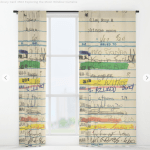
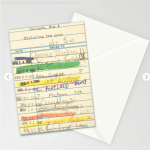
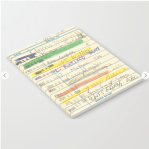
Library Card 3503 / Exploring the Moon
 This library card comes from an old copy of Roy A. Gallant’s “Exploring the Moon” and shows the circulation history of this particular edition throughout the 1980s.
Gallant has been a professor at the University of Southern Maine since 1979 and is the director there of the Southworth Planetarium. Before that however, he began his writing career with “Boy’s Life” magazine. When his article on the origin of the moon resulted in hundreds of letters of interest, he began to consider a career as a science writer.
Gallant’s first book, “Exploring the Moon,” was published in 1955 and not only sold over 100,000 copies but led to a series of ‘Exploring’ books touching on chemistry, weather and planets.
This book was, for many, an introduction to the Moon, as it would be another fourteen years before Neil Armstrong set foot on it, and four years before the Soviet Union crashed their Luna II probe into the surface.
Gallant’s career would span 50 years and include 96 titles. His last book, “Meteorite Hunter”, was published in 2001, and chronicled his journey across Siberia in search of anything related to the Tunguska Event of 1908, an unexplained explosion said to be 1000 times more powerful than Hiroshima.
Visit our shop at Society6 to see this library card and more on a variety of great products!






Listening to “Finding Cleo”
How the search for the truth about one young girl who disappeared forty years ago can bring the greater tragedy of Canada’s Indigenous peoples to the forefront.
 Its remarkable how one family’s story, the story of one young girl, can represent a larger tragedy. As I’ve listened to this story unfold, that thought has come back to me again and again. I recently listened to the first episode of the podcast “Finding Cleo” podcast through David Ridgen’s “Someone Knows Something”. I highly recommend all the seasons of that podcast as well, as David is so thoroughly Canadian and polite and wholesome as he investigated unsolved disappearances, you can’t help but be sucked in by it.
Before I’d even finished the first episode I was searching for more information and had started writing what would become an Instagram post and then this blog post.
The story of Cleo is a haunting and disturbing introduction to one woman’s search for the truth about her sister and the broader, dark chapter in Canadian/Indigenous history. This story does not just exist within Canadian history, however. Examples of similar attempts at eradication can be found in the United States’ treatment of its own Native tribes or the treatment of those who were or considered inferior or intellectually disabled in the early twentieth century. While the abhorrent behavior of those in power toward those who had none is not new, this podcast is able to narrow a broader tragic story down to focus on the dismantling of one family and the mysterious end of one little girl.
CBC News is launching Season 2 of the podcast “Missing and Murdered” with host Connie Walker about a family’s search for Cleo Semaganis Nicotine, who was adopted out of her Saskatchewan First Nations community and sent to live in the U.S. 44 years ago. During the first three episodes the mystery of just what happened to Cleo deepens as it’s revealed she may not have been adopted to Arkansas as originally believed.
The last time any of them saw her was in 1974 in rural Saskatchewan when Cleo was allowed to say goodbye to one of her brothers before she was taken to her new adoptive family. Her brother was himself adopted to the States, with government officials essentially bribing him in order to gain his complacency, before he sending him to a childhood of what amounted to slave labor in the United States.
Cleo was nine years old when she was stolen from her family, and she was one of thousands of Indigenous children caught up in what is now known as the Sixties Scoop.
Cleo was believed to have been sent to a foster family in Arkansas and killed while trying to hitchhike back to Little Pine First Nation in Canada, but no one had been able to say for sure how much of that was true.
Now Christine Cameron is joined in her search for the truth about her sister, and answers about the Canadian government’s attempted eradication and forced assimilation of First Nations people.
Listen to “Finding Cleo” on iTunes and visit CBC for photos and more.


 Gas Station Burrito
Double Spacing and the Legacy of Roy Hobbs
Mar 26
Posted by mattS
It seems to be a rather divisive topic too. Check out the original article and let me know what you think. Most of the comments were people asserting that they were, in fact, still alive, which I take to mean they are still double spacing after a period and take great offense to the author’s presumption all double spacers have died out with Roy Hobbs.
Personally, the double space as a habit pops up more so when I’m typing on a keyboard. Sadly, most of my writing these days is done on my phone simply as a matter of convenience. I write in very, very short bursts when I can, since like most of you, I’m usually doing twelve other things. When I end a sentence therefore and hit the space bar twice on my phone, it will insert a period and single space before auto-capitalizing for next sentence. The old double space isn’t an problem for then, but if I’m typing on a keyboard, I’m constantly going back to delete unnecessary spaces.
And they are unnecessary. There’s an entire Wikipedia entry devoted the history, evolution and misconceptions of the double space. Its a riveting story; Amazon already bought the rights to it, so extra spacing should be exclusive to Prime members soon. You can debate it all you like, but despite your Facebook comments, civilized society has established the rules of the new world order of typesetting already. Quite a while ago, actually. According to the Complete Manual on Typography from 2003, “The typewriter tradition of separating sentences with two word spaces after a period has no place in typesetting” and the single space is “standard typographic practice”.
The Elements of Typographic Style from around the same time also advocates a single space between sentences. They also said, “your typing as well as your typesetting will benefit from unlearning this quaint [double spacing] Victorian habit”.
In the cutthroat world of typography that may be about as close to a mic drop as it gets.
So for anyone clinging to their double spaces, now you’ll have to adjust your monocle and yell, “Take that, Reginald!” every time you maniacally double space.
Despite the typographic mic drop and the fact that the Daily Mash article was a joke, (and that Roy Hobbs is not real) the debate over redundant spacing rages on and certainly isn’t limited to one grammatical/typographic quirk. Several people saw fit to drag the Oxford comma into it, although there’s no word on what Roy Hobbs had to say on that matter
For a limited time you can support a cause dear to Roy’s heart by purchasing your very own official Roy Hobbs’ commemorative “Make America Double Spaced Again.” hat.
Share this post
Posted in Comments, Culture, Writing
Leave a comment
Tags: Amazon, daily mash, double space, facebok, Facebook, hugh howey, make america, make america double spaced again, mic drop, prime, roy hobbs, satire, single space, typesetting, typewriter, typography, Wikipedia, zazzle